
There is a spot in the Shabbat morning service where we pause and acknowledge the community. We bless our leaders throughout history; we pray for those who keep the synagogue running and fund the kiddush; we pray for our country, and we pray for Israel.
 But what about those sitting next to us in the pews? How do we acknowledge, embrace and value one another? When our rabbi asked me to consider answering those questions with a new prayer, I spent months pondering the answers. I journaled about them, asked them aloud, and posed them to myself. I even searched the Internet. Surely someone had attempted this before. I found prayers celebrating disabilities and prayers for queer communities and mental health. But I couldn’t find one that asked me to slow down and pay attention to the assumptions I make about the people around me.
Ritual is a funny thing. We repeat the same words and the same motions in the same order over and over; the routine can be soothing or numbing. My grandfather prayed daily, often in the dining room. My grandmother could ask him a question in the midst of his davening, and he would answer her without missing a beat.
I wanted my prayer to become familiar, but also to serve as a reminder: We bring our whole selves to this communal place. Every part of us matters.
When I felt like I had it down, I shared the new prayer with my synagogue community on Shavuot, a holiday where we celebrate receiving the Torah from God. Tradition has it that we all stood at Sinai – every one of us in every generation – and received the Torah together. On Shavuot it’s as though we are given that gift all over again. We have the honor and responsibility to honor our tradition, while also enriching and engaging with it in new ways throughout our lives and across generations.
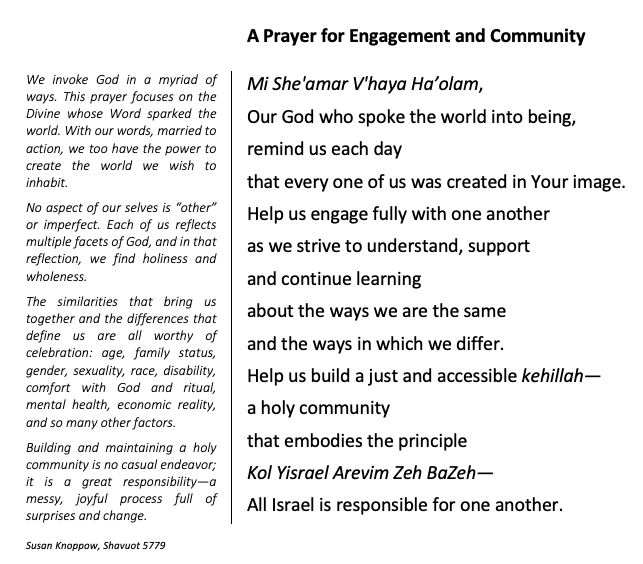
Here is my contribution.
With community in mind, thanks are due …
- To Rabbis Mitch Parker and Nate DeGroot who suggested early edits and encouraged me to carefully consider the name I used for God.
- To my husband, David Saperstein, who connected so deeply to the original draft, he didn’t want me to change a word. In a loving argument one warm blue night as we walked the dog in a wide loop around the neighborhood, he helped me consider every word anew.
- To Miriam Saperstein, my oldest child (and resident religious/social justice scholar), who taught me that the selves we bring to shul reflect our experiences outside the synagogue, and that the word “inclusion” risks whitewashing our heartfelt efforts to embrace all members of our community.
- To my friends and fellow congregants who participated in Bnai Israel’s 2019 Tikkun Leil Shavuot (our all night study session), who listened and challenged and embraced these new words, most especially to Geri Feigelson, who eloquently explained the differences between dismissal, tolerance, acceptance and engagement, from her perspective as a blind person: “When you tolerate me, you seat me in the corner. When you accept me, you bring me into the main area. But when you engage with me, I feel like part of the community.”
- And to members of the Bnai Israel Synagogue religious committee, who suggested edits for clarity, readability and yes, accessibility.
Feel free to share and recite this new prayer in your community as well. Here’s a pdf you can save.
 Writing It Down