
I stopped praying in early April.
God and me? We’re fine. It’s just that prayer has always been something I do with others. These days, the safest way to gather is on Zoom. And Zoom is no friend to a religious service.
Here’s how you do it: The leader keeps her microphone on. Everyone else goes mute. We can watch each other sing, but we can’t hear anything. Leading this type of gathering means praying alone, but on camera.
It’s disconcerting. I’ve never liked the performative aspects of leading services. I find it meaningful and moving to facilitate prayer, but to muster the appropriate kavanah, or intention, I need to hear the other voices. I need to settle into the communal silence. I can’t do that on a video call from my living room.

I can sing. I have the right kavanah. I care. All of that makes me a good shaliach tzibur – literally the “messenger of the community,” the one who has been sent to approach God on behalf of the congregation.
As a qualified leader, should I put aside my discomfort to ensure that others can fulfill what many consider an obligation, and which at the very least, is a central component of organized Judaism?
Maybe. But it seems disingenuous to play the role just because others need me to.
Is that selfish? A cop-out?
Perhaps.
I’m still figuring it out.
I’ve always considered the shul, the synagogue, an extension of my home. It’s the place I brought my children when they were small, where I go to be with my chosen extended family: the cranky, conservative uncle, the fawning cousin who hugs a little too much and a little too tight, the gentle aunt who you know has a more interesting life than you can imagine as a child.
I miss that home. I miss the people.
I miss the folks who drink coffee in the social hall during services. I miss the ushers who pass out prayer books and hugs as we enter the sanctuary. I miss the blue upholstered chairs and the light above the Ark with its awkward folding doors and needlepoint panels. I miss carrying the Torah around the room before the sermon, making sure that everyone has an opportunity to touch its cover before I return it to the Ark.
I miss taking my turn cutting up cantaloupe for lunch in the kitchen.
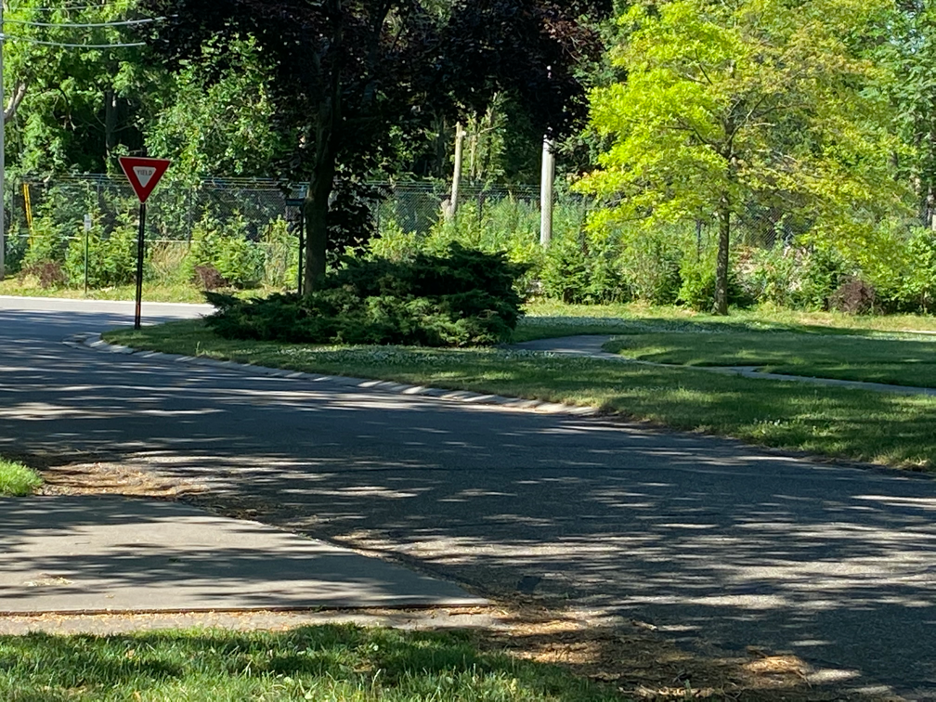
For the last few months, instead of praying on Shabbat mornings, I wander the neighborhood with a friend. We say we’re on vacation from shul. We feel relieved and a little guilty.
After decades of religious services, I know that I like two varieties: Friday evenings when we invite friends and neighbors into our living room, a service where we bang on tables and can get up to grab a drink or a snack; a service where we face one another in full song to welcome Shabbat.
I can’t even begin to imagine when or how we’ll do that again.
I also like the kind in the synagogue on a Shabbat or holiday morning, where I’m facing away from the congregation, engaged with God, drawing my synagogue family into that space between here and there with my words, my voice, my pacing, the call and response.
When my oldest child celebrated becoming a bat mitzvah, they lead musaf, a central part of the Saturday morning service. After I knew they had mastered the words and the melodies, I explained that serving as shaliach tzibur is a responsibility. You’re not just singing up there, I said. You are helping the congregation pray.
From the earliest days of communal prayer, back when no one had books, the leader chanted on behalf of the congregation. Amen signaled that community members heard and agreed with the leader’s words. You had to get it right.
Whenever I learn a new service, I spend hours going over the words. It’s old fashioned stuff, archaic Hebrew, some Aramaic. Nothing you’d hear on a city street.
Then the melodies. I play the recordings while I run early in the morning. I sing under my breath as the sun rises. Over and over, until I’ve absorbed the phrasing, the rising and falling, the pauses and punctuation. I make cryptic notations on the pages. I can tell you when and where I learned a specific prayer. I know which ones I mastered in Sunday school and which ones I worked on during summer vacations in Maryland or West Virginia.
Our rabbi called Sunday afternoon. He wanted to know if he could count on me to help lead Shabbat morning services again, the way I used to. We’re trying something new – Zoom services on Saturday morning. Even the most observant congregants, the ones who don’t use technology on Shabbat, can justify this approach: Log into Zoom before sunset Friday, then join the gathering Saturday morning.
To those unaccustomed to the laws of Shabbat, this may sound like splitting hairs. As someone who is quite accustomed to the laws of Shabbat, I’ll admit that it sounds like splitting hairs to me too. But that’s not the point. The point is that we’ve found a way to gather, albeit imperfectly.
Will I do it?
No, I said. I can’t.
I am sad about this, but I can’t facilitate something that makes me cry.
Do I have an alternative?
No. At least not yet. I can’t pray on a video call, and so I cannot lead my community in prayer that way. I am sorry to let them down, but I know they will find a way without me.
Maybe it’s a cop out. Maybe it’s a sidestep. Maybe I’ll miss it and change my mind.
For now, I like my fluid Saturdays. I like my walks. I like my friend’s four-year-old keeping his distance from my puppy as we go in search of big trucks and lawn mowing crews.
I like the trees and the sidewalks, and I’m getting used to the dance of neighbors stepping into and out of the street to give each other space.
It’s not a substitute for communal prayer, but for now it will have to do.

 We practically live down the street from each other, but I never see him. How do we lose track of people and keep them at the same time? I text him and tell him what I’ve been hearing today, that it must be a sign that we’re due to meet for a drink soon. We’ll go to the same place – Cork Wine Pub in Pleasant Ridge – and sit at the bar and have a couple of glasses of wine and some snacks. We’ll catch up and say we should get together some time soon, but we won’t.






 Writing It Down