Beyond the Binary – A Speaker’s Journey

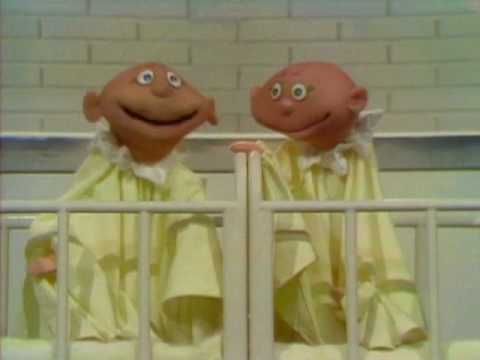
I start my presentation on gender with a snippet from Free to Be You and Me and an embarrassing personal story – the time I realized that I knew far less about gender than my children do, far less than I thought I did. The time I learned (again) that one of the best ways to guide our children is by listening to them, not trying to teach and correct them all the time.
When I speak, I tell my audience that I began writing about gender because I couldn’t find much in print or online from a parent’s perspective. And once I began writing, I was asked to speak on the subject – first to a retirees’ education group, a year later at a Jewish learning festival; I was asked to facilitate a discussion with local educators, and then served on a panel with college counselors and admissions officers from around the world.

Last year, I proposed the session for the Independent Educational Consultant Association’s annual spring conference, a place where I am known as the college essay lady, not the gender mom. But who knew? They respect my expertise; maybe they would give me a platform. Maybe I could fill a conference room.

And then, thanks to Covid, the conference went virtual. Instead of flying to Connecticut, members could join from their kitchen tables and home offices. Registration exploded. Hundreds of people streamed dozens of sessions.

By the time the conference ended, more than 500 people had viewed my session – far more than the 80 or so who would have selected it from the menu of in-person options.

The morning the conference started, I received an email from a colleague I know only peripherally; someone I like and respect, kind of a big shot in our professional community:

I’m 20-something minutes into your video and I just have to say this one of the most remarkable sessions I’ve seen at a professional conference. The content is so thoughtfully curated and the delivery is pitch perfect. And my first [conference] was in 1994 so I know what I’m talking about. Thank you for putting so much head and heart into this. What a great start to my day!

What a great start to my day.

I had no idea how this would go over. My experience as a parent, presented to a group of independent counselors. It certainly hit a nerve. I received heartfelt messages from people I knew and many I didn’t. Parents of trans and non-binary children. Counselors trying to support their student clients.

Another colleague, the Director of Learning and Development at CIP, a post-secondary transition program for young adults on the autism spectrum and with other learning differences, asked if I would present a similar session for CIP staff and families. I wouldn’t be talking about autism or learning challenges, but she said that gender was a big topic of conversation in their community. She would open it up to the public.

Again, amazing.

During that webinar, I talked about community support and engagement, about the ways in which parents, teachers, counselors and others can do more than simply accept gender non-conforming youth; how we can engage in learning and sharing related to gender. How we need to practice the names and pronouns of our children and students when they’re not with us, so we’ll get it right when we see them face-to-face.

Again, emails and thank-you’s.

If you’re interested in the webinar, CIP has generously made the recording available to the public. You can check it out here.

And let me ask you something too: Spread the word. Our children know more about gender than we do. Listen, learn and practice. Give them space to create the world they know they need. And then dig in and do the hard work of participating.

Pandemic Haircut

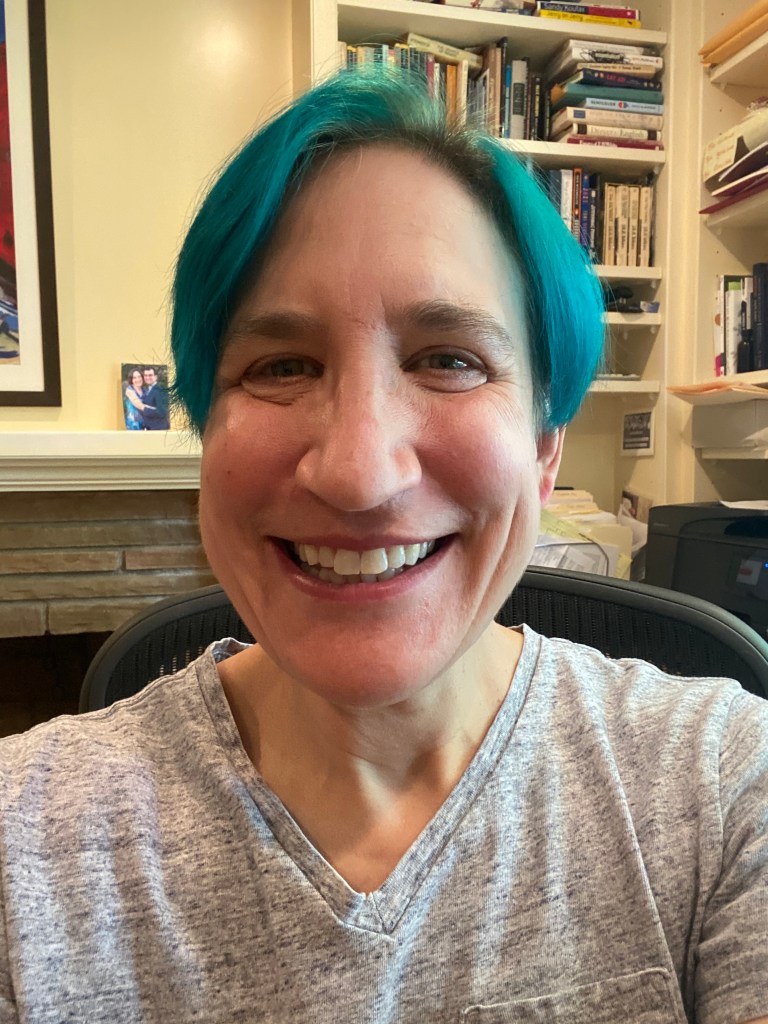
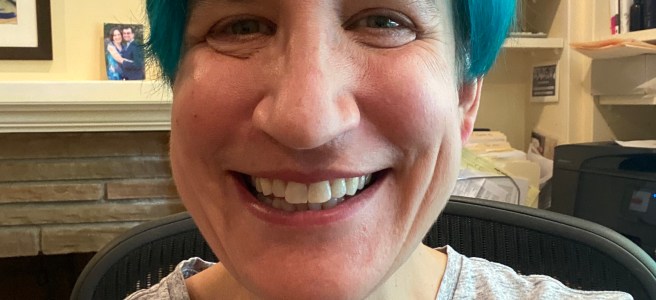
My first thought on removing the plastic bag and rinsing out the extra dye was “troll doll.” Not the giant eyes and round belly. But the hair. Definitely the hair – bright mermaid blue. After some challenging weeks (David’s bike accident, friends suspecting Covid – which, fortunately, turned out to be a false alarm), here was something to celebrate.

Friday afternoon, Birch cut my hair on our deck – the first clippers to touch my head since February. Yesterday, I let her dye it. Because … Why not? My children have been dying their hair for years. I’ve long wondered what it would be like to color mine.

But I don’t do that sort of thing, so I set the idea aside. Until this weekend.

These days, everything feels uncertain, ad-hoc. What difference does it make what color my hair is? And what difference does it make if that dye job is the perfectly imperfect work of my sixteen-year-old? It’s joyful. It’s fun. It’s hair, for heaven’s sake.

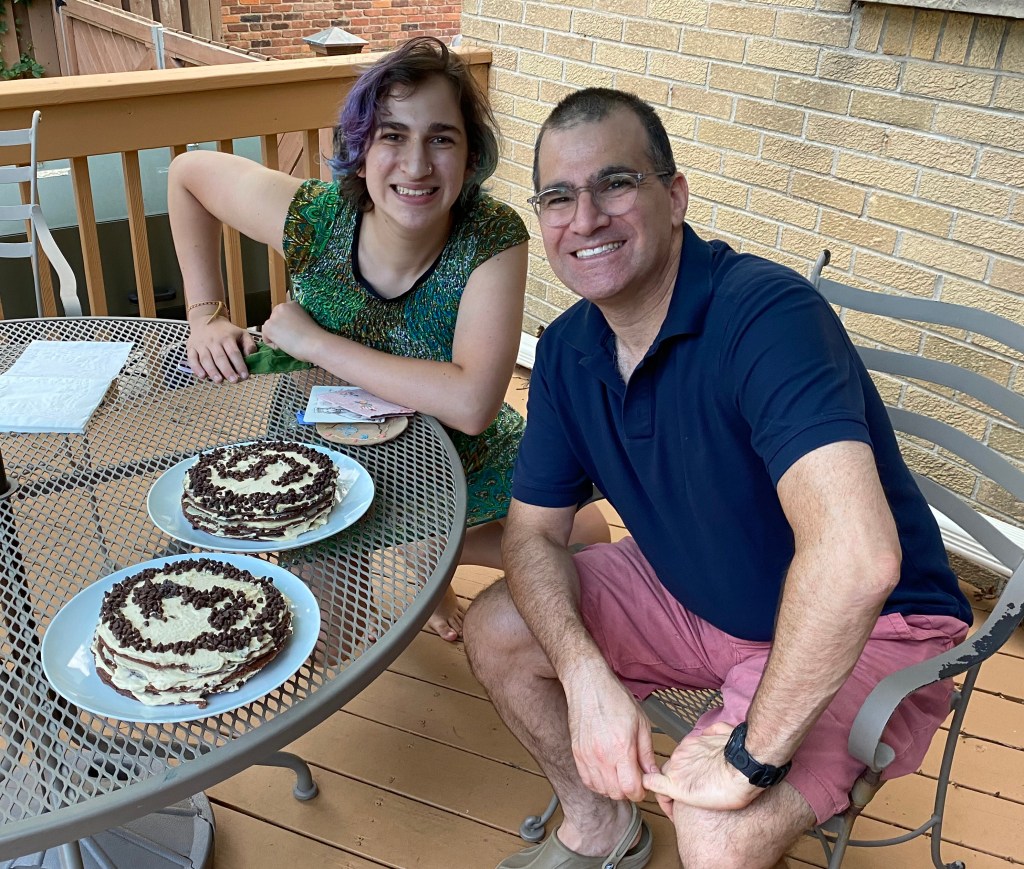
Last night, we celebrated David’s 53rd birthday. Birch made a chocolate peanut butter icebox cake (highly recommend; here’s the recipe). Miriam and Sammy visited from Ann Arbor, where they are each living in coops with 15 young adults. It was our first family gathering since they left home again in July.

They arrived wearing masks.

We sat on the deck, six feet apart.

They didn’t stay overnight.

I loved being with them. All week I felt excited and sad – anxious to see them, sad that we couldn’t hug, relieved that during this isolating time they are living in community.

Birch had 12 days of community at Camp Lookout too, the best part of her summer hands down. This was her fourth season at the tiny camp in Northern Michigan, the capstone session before being old enough to work there next year.

When Governor Whitmer moved our state into Phase 4, the directors figured out a way to offer tiny camp experiences for kids from the same region of the state. Camp was back, albeit with masks and distance and pre-arrival Covid tests.

And now they’re even offering a semester school option, which my kid is anxious to join – seven weeks of online school with your home district, while engaged in a camp-like community up north.

So, things are looking up in unexpected ways.

And I have turquoise hair, which I love.

My children are finding their way during this odd time. Birch is settling into communities that embrace and celebrate her trans identity – folks who don’t question her name, her pronouns or her politics.

Sammy’s friends are returning to Ann Arbor after scattering when school shut down in March. They are walking and talking together-but-apart, sitting on the porch, sharing meals as best they can.

Miriam is working at a farm a couple days each week, figuring out what the fall of senior year looks like, navigating uncertainty like a pro.

No, it’s not what I expected. But it’s what we’ve got, and I’ll take it.

A Prayer for Engagement and Community

There is a spot in the Shabbat morning service where we pause and acknowledge the community. We bless our leaders throughout history; we pray for those who keep the synagogue running and fund the kiddush; we pray for our country, and we pray for Israel.

35895262-tulip-flower-imagesBut what about those sitting next to us in the pews? How do we acknowledge, embrace and value one another? When our rabbi asked me to consider answering those questions with a new prayer, I spent months pondering the answers. I journaled about them, asked them aloud, and posed them to myself. I even searched the Internet. Surely someone had attempted this before. I found prayers celebrating disabilities and prayers for queer communities and mental health. But I couldn’t find one that asked me to slow down and pay attention to the assumptions I make about the people around me. Continue reading
Gender: Listening without Judgement

I listened to the interview Saturday night, under the covers with David, not sure if I would still like my answers to Piya Chattopadhyay’s questions.

Piya, a Canadian radio personality, hosts a program called “Out in the Open” on CBC Radio, where she explores one topic each week from multiple perspectives. The most recent episode, Whither Gender, includes an interview with me, talking about coming to terms with having a non-binary child.

The show offers a multi-faceted exploration of how we think and talk about a certain gender construct. Is it as complex and complete as it could be? Certainly not. But it’s still excellent. And anyway, that’s not my point.

Continue reading

Pronouns – Self-Correcting, Haircuts and Parenthood

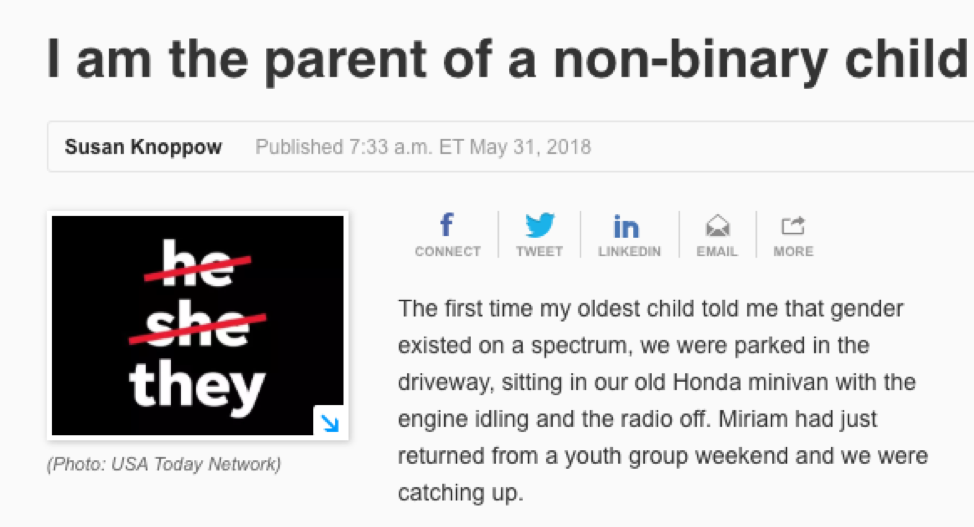
Last week I received this comment on my blog, I am the Parent of a Non-binary Child:

I’ve read this post more than once since my kid came out to me as non binary. I just need to give a shout out somewhere to all the self-correctors out there. For all those friends and advocates who are working hard to make sure my kid feels accepted for who they are… Every time you use an old pronoun and then immediately update in an almost hyphenated fashion…we hear you. We hear you trying. And we thank you for your efforts. It’s not automatic or easy to make this adjustment or to admit a mistake in the same breath, in your very next word… to a child. I just want to give credit where it is due.

I couldn’t have said it better myself.

image - pronoun sticker

I just had this conversation with Amy, who has been cutting my hair for as long as we’ve both had children (me first!) She cut my children’s hair when they were younger, and always asks about them. Sometimes she gets Miriam’s pronouns wrong, and I correct her. And we laugh. Because being a mom is complicated enough without giving each other a hard time for something that’s hard to remember.

Don’t apologize, I tell her. Don’t apologize, I tell my friends, my extended family, the people I meet along the way. Just correct yourself. Say it again. Listen to what “they” sounds like, what it feels like in your mouth.  Continue reading

Happy Children’s Day (in Argentina)

How cool to receive this email last Thursday, with a Spanish translation of my Free Press article:

Asamblea No Binarie

Hi Susan, my name is Ailén, I’m from Buenos Aires, Argentina and I’m a member of the Asamblea No Binarie here. We’re a nonprofit organization and activism group of non binary people. We found your article, I am the parent of a non-binary child, very interesting, and specially due we’re close to a holiday, child’s day. We’ll like to publish your article and its proper translation into spanish in our facebook page https://www.facebook.com/asambleanobinarie/ .


Happy Children’s Day! Here’s the Facebook post from Argentina. 


The Atlantic Misses an Opportunity to Bring a Nuanced Discussion of Gender to the Mainstream

After the Atlantic published a cover story by Jesse Singal Monday entitled “When Children Say They’re Trans,” I received an email from Caroline Kitchener, an associate editor at the magazine. It read, in part:

I’m looking for parents of trans or gender non-binary kids to respond to our latest cover story. Much of the piece reads almost like a letter to this group—of which I know you’re a part—and we’d like to start a thoughtful, productive conversation around it. I read your great essay in the Detroit Free Press, and am wondering if you might want to participate: What does Jesse get right in the piece, and what does he get wrong? What could be the potential implications of a piece like this? Continue reading

Response: “They” is Too Confusing

Yesterday I received a comment on my post, On Parenting and Pronouns, that I want to share, reflect on and, ultimately, argue against.

Here’s the comment:

There has to be a better way. Using they is too confusing. You are not communicating. My solution: don’t use pronouns at all. To the waitress: I’ll take a coffee, but my partner won’t. Is Scooby upstairs? Tell Scooby dinner is in 10 minutes. Yeah it is awkward, but not more awkward than “they” and is miraculously clear.

Maybe English will develop a gender neutral pronoun. Until then, find a way to make a gender neutral person comfortable AND communicate without confusion to that person and all others. I spent my career in corporate communications and when this came up successfully eliminated hurtful pronouns and wrote text that communicated. No, a crowd is not coming downstairs for dinner.

Here’s my response: Continue reading

What Can I Do for You?

We like to ask, “What can I do for you?”

Frequently the answer is, “Nothing… but thanks for asking.”

How can this be? If I am sick or lonely or sad, and you ask what I need, shouldn’t I speak up?

A hug.

A gallon of milk.

A basket of laundry, clean and folded.

help image.jpeg

We answer, “Nothing, thank you,” because we don’t know what we need, or what we need is too much, or we can’t imagine how we would ask for the thing we need.

You didn’t even ask what I need, but I’m going to tell you anyway. I need something big. Continue reading